Transcript
Announcer:
You’re listening to Perspectives with the AMA on ReachMD, produced in partnership with the American Medical Association. Here’s your host, Dr. Mary Katherine Cheeley.
Dr. Cheeley:
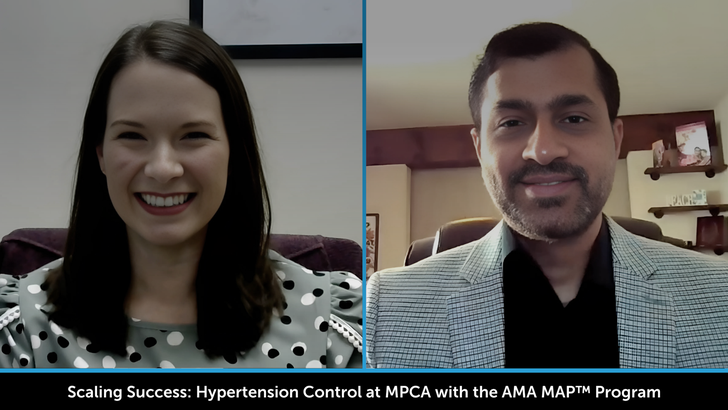
This is Perspectives with the AMA on ReachMD. I'm Dr. Mary Katherine Cheeley. Joining me to share his experience with the AMA MAP™ Hypertension Quality Improvement Program is Dr. Faiyaz Syed. He's the Chief Medical Officer for the Michigan Primary Care Association, or MPCA. Dr. Syed, welcome to the program.
Dr. Syed:
Thanks for having me.
Dr. Cheeley:
All right, start us off. Can you give us an overview of your responsibilities as Chief Medical Officer and how you and your team support other members of the Health Centers in Michigan?
Dr. Syed:
I have been with the Michigan Primary Care Association since 2012. Michigan Primary Care Association is the voice of 48 member Health Centers, including federally qualified Health Centers, tribal Health Centers, and also urban Indian health programs. Our members provide healthcare to over 400 locations across the state and serve one in every 15 Michigan residents. Our mission is to deliver excellent healthcare and advance health outcomes. And my job as the Chief Medical Officer for Michigan Primary Care Association is multifaceted. I work primarily with the clinical leadership across our membership. My team provides training and technical assistance focusing on clinical affairs, policy and advocacy issues, population health activities, grants, and evidence-based clinical guideline implementation support. And our end goal is helping the Health Centers in excelling when it comes to value-based care initiatives.
Dr. Cheeley:
Let's zero in a little bit on something that is near and dear to my heart, which is the AMA MAP™ program and that implementation at MPCA. What was that experience like for you? How has it changed the way that you and your members approach cardiovascular disease prevention and care?
Dr. Syed:
Through this partnership, we have worked on a lot of different things. One of the big collaboration wins that I want to share here is the AMA MAP™ reporting availability made within Azara. Azara is our population health tool that does a lot of analytics for us. And so using the AMA MAP™ metrics reports and scoreboards that are accessible within Azara, we launched the AMA MAP™ Hypertension program with two pilot Health Centers: Western Wayne and Grace Health. This was back in March of 2023.
Our initial goal was to have a reach of around 6,000 adult patients with hypertension. We got 5,070. And our pilot programs included a lot of work around controlling blood pressure for our 5,000 patients within those two Health Centers. And at the end of the pilot, we were able to see a 6-plus percent improvement in blood pressure control rates for our two Health Center patient populations.
And in November of 2023, we went ahead and activated the AMA MAP™ metrics that we worked with Azara and AMA to develop, and now it is made available for all of our MPCA members. And luckily for us, all of our members, maybe except two Health Centers that are newer, use Azara as their population health platform for data analytics. So the initial reach was around 6,000 hypertensive patients, and now with the availability of the AMA MAP™ metrics within Azara, the reach has increased to 121,667 adult patients within our network that are hypertensive patients.
Dr. Cheeley:
So how did you guys use the information that you were getting from the AMA MAP™ program to engage and educate your patients?
Dr. Syed:
So this partnership worked beautifully because both the AMA and the MPCA teams had clinicians. On my team, I had a few nurses that really helped with the program implementation, the clinical workflows, and coordinating with the Health Centers. And on the AMA side, we had clinicians as well that we were working with. So it was a really good partnership that allowed us to work together to engage with our Health Centers on not only training their staff and their providers, but also educating the patients on the AMA MAP™ Hypertension program.
The other aspect of this partnership, which really worked, was that constant feedback loop. So we had regular touch-in meetings. The AMA team and MPCA team were meeting at one point, initially, almost weekly to re-tune the program based on the feedback we were receiving from our Health Centers regarding some of the challenges that were associated with provider times. We tried to accommodate all of that and make it easier for the Health Centers and the staff to participate in the program. And all these insights from the MPCA team and our member Health Centers actually helped AMA develop a network learning series that was more in tune with the needs of the Health Centers, making it easier for them to participate. All of the learning series are now available to everyone across the country that is an Azara user.
Dr. Cheeley:
For those just tuning in, you're listening to Perspectives with the AMA on ReachMD. I'm Dr. Mary Katherine Cheeley, and I'm speaking with Dr. Faiyaz Syed about the implementation and impacts of the AMA MAP™ Hypertension Quality Improvement Program at the Michigan Primary Care Association.
Dr. Syed, I am loving the conversation that we're having, so I want to dig even a little bit deeper. Can we talk about your experience with the AMA MAP™ Hypertension Program and how that program has aligned with the broader strategic goals of MPCA?
Dr. Syed:
So MPCA has been working with all of our membership on value-based care contract initiatives. What that basically means is shifting from volume to value-based care, and the focus on outcomes becomes a huge impact for our contracts. And so we have for a long time been propagating the use of care teams for taking care of our high-risk, high-cost patients. So care management is a big thing. And so from the care management perspective, we need a care team that is working in coordination to improve outcomes. And that care team now consists of the provider, the MA, the nurse care manager, the community health worker, and the social worker. It's a team effort.
And so through this pilot, one of the things that really was a valuable learning lesson was how to use a pharmacist within this program. Because in many of our Health Centers, the pharmacy is within the four walls of the Health Center, and so leveraging the pharmacist and working with the physician in improving the goals of this program has worked beautifully. And the pilot has showcased that with one of our Health Centers, Grace Health, by implementing a program where a pharmacist was leading it. And so it has definitely helped with our strategic goals of utilizing every care team member to the best of their abilities.
Dr. Cheeley:
I understand, a little birdie told me, that you guys have recently expanded your collaboration between the AMA and MPCA. What does that look like? What are you guys hoping to do to build on the work that you're already doing?
Dr. Syed:
So, as I mentioned, our initial goal was to start with a small pilot. That pilot has shown the results that we were hoping for. When implementing this program helps you in improving the blood pressure control rates, I think a lot of the other Health Centers will benefit from it. So from that small pilot with two to three Health Centers, now our goal is to scale it to all of our membership. And as part of those efforts, we have used the AMA MAP™ Hypertension framework to embed that within our clinical pathways for hypertension that the network has created. And that pathway is utilizing the care teams and allowing them to use evidence-based guidelines, including AMA MAP™ framework.
So the focus when we started was on hypertension, but recently, we—as in the MPCA and AMA teams—have been discussing the potential to expand it to other disease conditions.
Dr. Cheeley:
Before we close, Dr. Syed, do you have any final comments you'd like to share about the AMA MAP™ Hypertension program?
Dr. Syed:
The providers have access to tons of evidence-based guidelines, but sometimes I think it’s too much for anyone to sift through to get to something that is easily implementable. So our partnership with the AMA MAP™ Hypertension program and the support that we have received from the AMA team has been invaluable in making it easier for the Health Center providers to access this information. The training and technical assistance offered through this partnership has improved the staff and provider workflows in managing hypertension, which again, I want to reemphasize that within our population that we serve at the Health Centers, it is one of the largest chronic diseases impacting the health outcomes of our patient population.
And so basically, based on all the positive experience working with the AMA team, I would recommend that PCAs and Health Centers should consider partnering with the AMA to implement the AMA MAP™ Hypertension program. Our journey together has been very fruitful, and I have been nothing but appreciative of what AMA has brought to the table and helped us with implementing an evidence-based program like AMA MAP™ Hypertension.
Dr. Cheeley:
I think that's a perfect way to close our discussion today. Dr. Syed, I am so grateful for you to be here to chat about your experience with the AMA MAP™ Hypertension Quality Improvement Program and the collaboration that you built with the Michigan Primary Care Association. I think it's a great way to show that this can be done, and it can be done on a big level. So, Dr. Syed, it was lovely having you on the program.
Dr. Syed:
Thanks for having me. It has been a pleasure.
Announcer:
This was Perspectives with the AMA on ReachMD, produced in partnership with the American Medical Association. To access this and other episodes in this series, visit Perspectives with the AMA on ReachMD.com, where you can Be Part of the Knowledge. Thanks for listening!